
AI SEO guide • updated April 10, 2026
How to Track AI Search Visibility
Tracking AI search visibility sounds straightforward until you actually try to do it. Then the confusion starts. Search Console does not hand you a neat little “AI visibility” report. AI answers can change fast. Brand mentions do not always behave like rankings. And half the advice online still sounds like people are trying to force old keyword thinking into a different kind of search experience.
So this page takes a calmer route. Instead of pretending there is one perfect metric, I want to show you what is worth watching, what is noise, and how to build a workable visibility tracking system that still makes sense if you run a real site with real content instead of a dashboard addiction.
What this page helps you do
- Understand what “AI search visibility” really means
- Track the right signals without inventing vanity metrics
- Combine Search Console, on-site behavior, and AI visibility tools sensibly
- Build a repeatable reporting workflow that feels useful, not performative
Quick answer: how do you track AI search visibility the right way?
Track AI search visibility in layers, not as one magic number. First, use Search Console and analytics to watch overall search performance and what happens after the click. Second, use manual or tool-assisted AI visibility checks to see whether your brand or URLs are being cited, mentioned, or surfaced in AI answers. Third, measure whether those mentions are attached to the right pages, right topics, and useful business outcomes. That last part matters a lot more than collecting screenshots of a single AI Overview.
The useful mindset shift is this: AI visibility is not just “did I rank?” It is “am I being surfaced, cited, or chosen when AI-led search tries to answer the question?”
What AI search visibility actually means
AI search visibility is broader than rankings. It covers whether your brand, site, or specific URL is being surfaced in AI-led search experiences like AI Overviews, AI Mode, and similar answer-driven results. Sometimes that visibility looks like a cited link. Sometimes it looks like a mention. Sometimes it is a summary built around your content. And sometimes the brand is present without sending much traffic at all.
That last part is exactly why old SEO habits can feel awkward here. In classic SEO, it is easier to think page by page, query by query, position by position. In AI-led search, the questions widen. Which pages get cited? How often does the brand appear? What kind of description is attached to it? Which competitors are being pulled in more often? Are the mentions happening on the topics you actually care about?
Why people get confused about tracking it
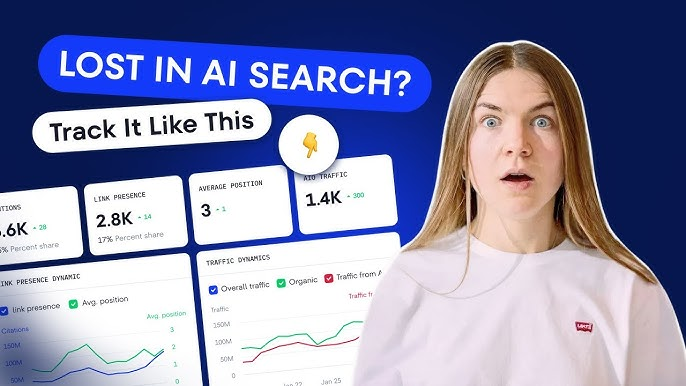
Part of the confusion is cultural. SEO trained us to love clear rankings, obvious CTR changes, and tidy position reports. AI search visibility is messier. Google folds AI features into its normal search reporting, which means you cannot just open Search Console and click an “AI visibility” tab for the full picture. Meanwhile, third-party tools are trying to model a fast-moving search behavior that does not look exactly like ten blue links anymore. That makes the topic feel more mysterious than it really is.
The second problem is emotional. People want one score. One chart. One screenshot they can drop into Slack and call it progress. But AI visibility is closer to brand monitoring plus search performance plus topical coverage. That is not as sexy as “position 3,” but it is a lot closer to reality.
The useful mindset shift: stop asking for one master metric. Start asking whether your brand is appearing more often, on the right prompts, with the right pages, and with the right downstream behavior.
A practical framework for tracking AI search visibility
Layer 1: overall search movement
Use Search Console and analytics to watch impressions, clicks, page-level changes, and what people do after they land.
Layer 2: mention and citation visibility
Track whether your brand or pages are being cited, mentioned, or surfaced in AI answers on the topics you care about most.
Layer 3: business usefulness
Ask whether the right topics, pages, and visits are growing — not just whether a mention happened once.
This three-layer model keeps you honest. If you only watch mentions, you can fool yourself. If you only watch Search Console, you miss the AI-specific layer. If you only watch conversions, you may miss emerging visibility that has not matured yet. Together, the picture starts to make sense.
The signals that are actually worth tracking
- Brand mention frequency: how often your brand shows up across the prompts or AI-led searches that matter to you.
- Cited URL visibility: which exact pages get pulled into AI answers, and whether the “winning” pages match your priorities.
- Topic-level coverage: whether you appear on the right cluster of questions instead of one lucky query.
- Competitor overlap: who keeps appearing where you do not, and on what subjects.
- Description quality: whether the way your brand is described is accurate, weak, generic, or misleading.
- Post-click behavior: what visitors do after they land, especially for pages that target more complex questions.
- Refresh impact: whether updated pages improve visibility over time instead of only getting a temporary lift.
Keyword.com’s official positioning lines up with this pretty closely: brand mentions, citations shaping AI responses, competitor benchmarking, and sentiment-style analysis are all part of the product pitch because these are the kinds of signals AI visibility teams actually need.
What I would not obsess over
- One-off screenshots proving you appeared once in an AI answer.
- A single “AI visibility score” with no explanation underneath it.
- Exact replication of classic rank-tracking expectations inside AI-led search.
- Bragging about mentions that happen on the wrong prompts or the wrong pages.
- Watching AI mentions while ignoring whether the site experience after the click is terrible.
I think this is where a lot of reporting goes slightly off the rails. The dashboards are trying to simplify something that is genuinely multi-layered. That is useful up to a point. After that, you need judgment more than another chart.
A weekly AI visibility workflow you can actually keep up with
- Step 1: choose a small set of priority topics or prompts, not your whole universe.
- Step 2: review Search Console and analytics for the corresponding pages and query clusters.
- Step 3: check whether your brand or URLs appear in AI-driven responses for those topics.
- Step 4: note which competitor brands and URLs keep showing up instead.
- Step 5: refresh or strengthen the pages that should be winning those citations or mentions.
- Step 6: repeat weekly and look for pattern changes, not daily drama.
This is also why I like topic-first reporting more than keyword-first reporting here. AI search experiences often pull together broader intent, follow-up questions, and multiple supporting links. If your tracking model stays too narrow, you can end up measuring the wrong thing precisely.
Helpful tools for tracking AI search visibility
- Keyword.com: the clearest mapped fit for AI visibility tracking, citations, competitor benchmarking, and monitoring how your brand shows up in AI search contexts.
- Frase: useful when the tracking work shows your content needs better structure, clearer coverage, or stronger refreshes.
- Rankability: helpful if the visibility problem is partly a refinement problem and your pages need sharper improvement loops.
- ListingBott: relevant if discoverability and broader citation support matter for your business model, especially in SaaS-like contexts.
A simple rule of thumb: use visibility tools to spot the gap, then use content optimization and refresh tools to fix the reason the gap exists.
If you want a better reading path after this page, go next to Best AI SEO Tools, then How to Optimize for Google AI Overviews, and then How to Improve AI Citations for Your SaaS Site.
Final verdict
If you want the honest version, tracking AI search visibility is less about finding a secret score and more about combining signals that already exist. Watch your search movement. Watch your citations and mentions. Watch whether the right pages are getting pulled into the right conversations. And then watch what happens after people arrive. That is a lot less glamorous than pretending you found the master dial, but it is much closer to how useful reporting actually works.
The sites that win here are usually not the ones with the fanciest screenshot. They are the ones with the clearest topics, the strongest pages, and the discipline to measure visibility like a system instead of a vanity project.
FAQ about tracking AI search visibility
Is AI search visibility the same as keyword rankings?
No. Rankings still matter, but AI search visibility is broader. It includes whether your brand or specific URLs are being surfaced, cited, or mentioned in AI-led answers across the topics that matter to you.
Can Search Console show AI visibility directly?
Not as a full standalone report. Google treats AI features as part of normal search reporting for site owners, which means you need to combine Search Console data with page-level analysis and AI-specific visibility checks.
What is the most useful thing to track first?
Start with a small set of priority topics and monitor whether your brand or URLs appear consistently, not whether you showed up once on a random prompt. Topic-level coverage is usually more useful than isolated wins.
Do I need a third-party tool to track AI search visibility?
Not always, but a good tool can make the work much easier by monitoring mentions, cited URLs, competitors, and trends across prompts at a scale that is hard to maintain manually.
Why are screenshots a bad reporting habit here?
Because they can prove a moment without proving a pattern. AI visibility needs repeatable tracking across topics, citations, and post-click outcomes if you want to know whether your visibility is improving in a meaningful way.
What should I do after I find an AI visibility gap?
Fix the reason behind the gap. Improve the page, strengthen the topic coverage, refresh weak content, clarify the entity signals, and make the next click on your site obviously worthwhile.
PromoCodeRadar helps users find cleaner coupon codes, official deals, annual billing savings, free trials, and better ways to save on software, AI tools, and online services.
If you found a broken code or outdated listing, contact us at contact@promocoderadar.com.