
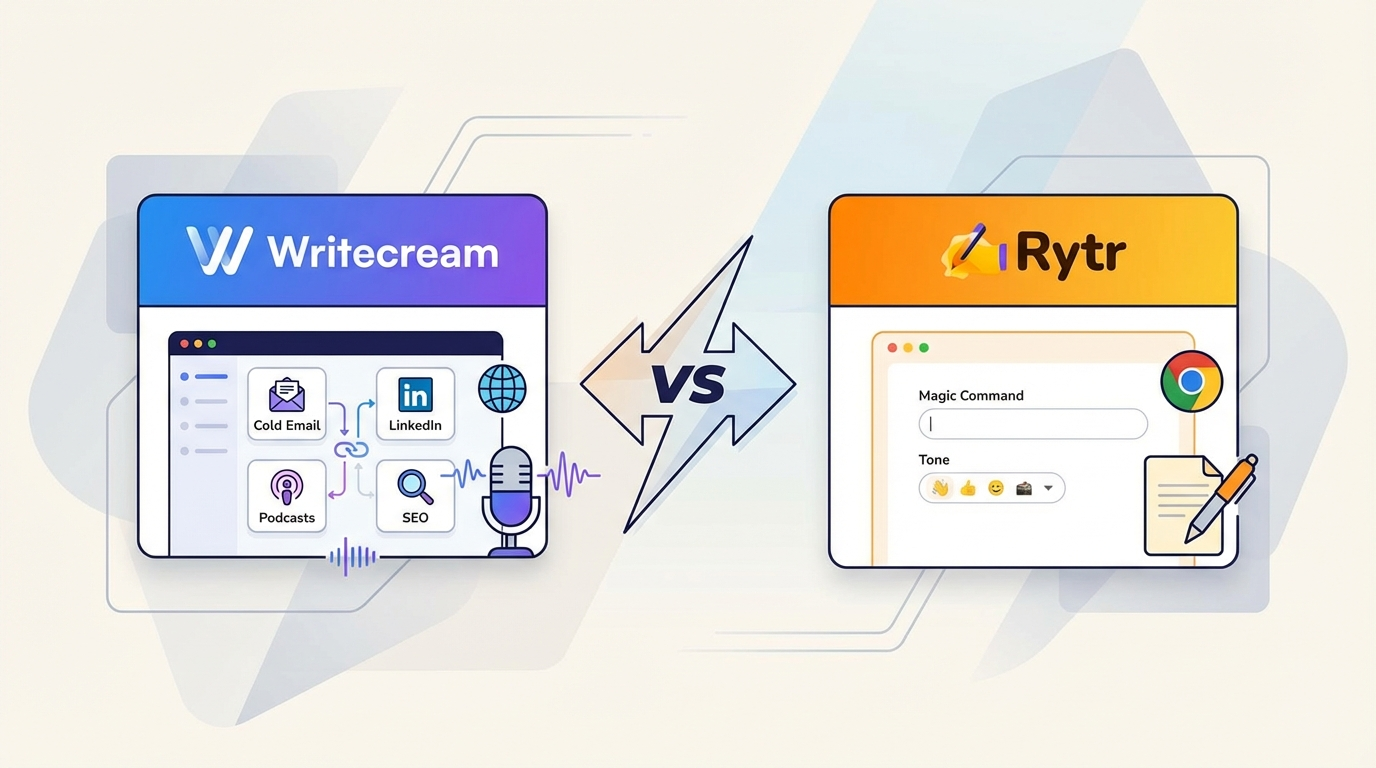
Rytr vs Writecream vs GravityWrite
Rytr vs Writecream vs GravityWrite is really a decision about what kind of writing problem you need to solve most often. These three tools overlap just enough to confuse buyers, but they are not equally strong for the same workflow. One is easier to justify for lighter short-form writing, one makes more sense when you want a broader all-in-one content stack, and one becomes more attractive when blog production and wider content workflows start to matter more.
If you are already down to these three, you probably do not need another giant roundup. You need a clean answer to a simpler question: which one is the safest fit for the way you actually write right now? That is what this comparison is for.
This article works best as a companion to Best AI Writing Tools, Best AI Writing Tools for Beginners, and the broader AI Writing hub.

Table of Contents
Quick verdict
If I had to simplify this comparison fast:
- Choose Rytr if you want the easiest fit for lighter short-form writing and you do not want a bloated platform.
- Choose Writecream if you want the broadest all-around content stack of the three and you expect to handle more than just one type of writing.
- Choose GravityWrite if your workflow is moving closer to blog production, content expansion, and a wider content system instead of just lightweight copy generation.
That is the short version. The longer version is that none of these tools is the “winner” in a vacuum. The winner changes depending on whether your real bottleneck is quick copy, mixed content production, or a broader blog-and-content workflow.
Rytr vs Writecream vs GravityWrite: quick comparison table
| Tool | Best for | Main strength | Main trade-off |
|---|---|---|---|
| Rytr | Lightweight short-form workflows | Simple setup, clear use cases, easier starting point | Can feel narrower if your workflow expands quickly |
| Writecream | Mixed content work across formats | Broader content coverage in one platform | May feel like more platform than some buyers need |
| GravityWrite | Blog-heavy and broader content systems | Wider blog and content workflow orientation | Can be less compelling if all you need is fast simple copy |
How I would compare these three tools
For this comparison, I would ignore the usual “feature checklist arms race” and focus on five things instead:
- Ease of use: how quickly a normal buyer can get useful output
- Template quality: whether built-in starting points actually reduce friction
- Short-form output: how well the tool handles fast practical writing tasks
- Drafting flexibility: whether it still helps when the workflow gets broader
- Value for lighter workflows: whether the platform feels worth paying for if your writing needs are not huge
This matters because comparison shoppers often do not need a perfect winner. They need the safest fit with the fewest regrets.
Rytr
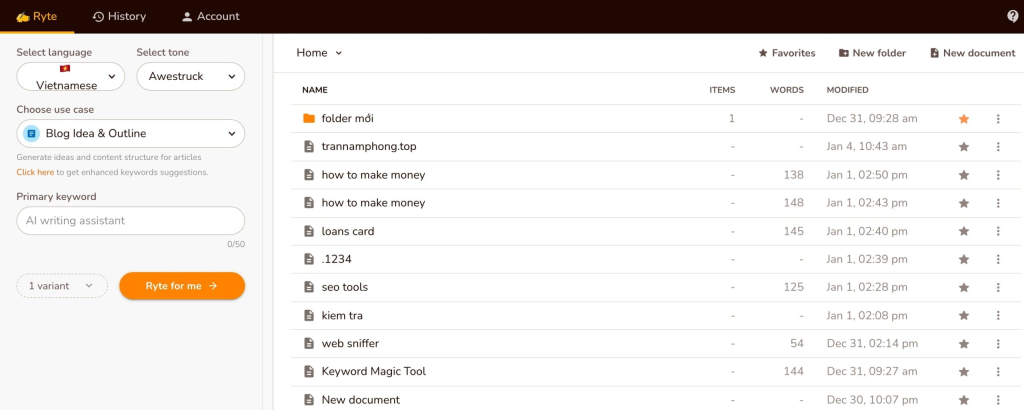
Rytr is the easiest of the three to justify when your workflow is still pretty simple. You want short-form copy, quick drafts, template-driven writing, tone variation, and a tool that does not overwhelm you on day one. That is where it usually makes the most sense.
I would put Rytr first if your workload looks like this: email drafts, product blurbs, short paragraphs, CTAs, social captions, light content help, and everyday copy tasks where speed matters more than building a huge content system around the tool. It feels more like a direct writing assistant than a full production environment.
Where Rytr wins
- Cleaner entry point for lighter workflows
- Easier to recommend to beginners or budget-conscious users
- Better when you want a writing assistant, not a broader platform commitment
Where Rytr falls behind
- Less attractive if you want a broader content workflow in one place
- Can feel limited once your work expands into heavier article production or multi-format systems
- Not the strongest pick if you are trying to build around a larger blog-content engine
Skip Rytr if you already know your writing workflow is becoming broader and you will quickly want more than simple short-form support.
Writecream
Writecream is the most obvious middle ground here if your workflow is messy in a realistic business way. You may need article help, outreach content, product copy, marketing assets, maybe even visuals or voice-related features, and you would rather not jump between several separate tools too early. That broader content stack is why Writecream often feels more flexible than Rytr.

The reason I would place Writecream ahead for broader mixed content work is not that every single module must be the best in class. It is that a broader platform can be the better buy when your content work is spread across several recurring tasks each week.
Where Writecream wins
- Broader content coverage than Rytr
- Better fit for marketers or creators handling multiple content formats
- Stronger choice when you want one platform to cover more of the stack
Where Writecream falls behind
- Can feel too broad if you only need a simple daily writer
- Not always the cleanest option for someone who wants minimalism first
- If your real need is blog-system depth, GravityWrite may look more focused
Skip Writecream if your workflow is extremely narrow and you mainly want the simplest possible tool for lightweight copy generation.
Open the Writecream store page.
GravityWrite

GravityWrite becomes more interesting when your workflow starts to look less like “help me write a few things” and more like “help me run a broader content engine.” If your attention is moving toward blog generation, content expansion, SEO-oriented writing, visuals, and connected workflow pieces, then GravityWrite usually becomes easier to justify.
I would not call GravityWrite the best fit for the buyer who only wants quick marketing copy. I would call it the stronger option when you expect article workflows, broader content output, and a more system-like content process to matter. Its docs also lean into blog-writing workflow, WordPress import, and internal linking support, which reinforces that broader content-production angle.
Where GravityWrite wins
- More attractive for blog-heavy or broader content workflows
- Better if you want a platform that stretches beyond plain text generation
- More aligned with users building a fuller content production system
Where GravityWrite falls behind
- Can feel like too much platform for simple copy needs
- Not the clearest first choice for ultra-lightweight writing tasks
- If all you want is a quick inexpensive helper, Rytr is easier to justify
Skip GravityWrite if your actual workload is still simple and you do not need a broader blog-and-content workflow yet.
Open the GravityWrite store page.
Who wins on each comparison axis?
Ease of use: Rytr
Rytr is the easiest one here to recommend if you want fewer layers between you and usable output. That matters a lot more than people admit when you are buying for speed.
Template quality: Tie between Rytr and Writecream
If you want a simpler template-first experience, Rytr feels easier to approach. If you want a broader menu of content jobs in one place, Writecream becomes more attractive. The better pick depends on whether you want simplicity or breadth.
Short-form output: Rytr
For lighter short-form writing, Rytr is usually the cleaner fit. It does not try to drag you into a bigger workflow than necessary.
Drafting flexibility: Writecream
Writecream is the safer middle choice if your drafting work is mixed and you do not want to feel boxed into one narrow use case too early.
Value for lighter workflows: Rytr
If your workload is small to moderate, Rytr is easier to defend financially and mentally. Broader platforms only become “better value” when you actually use their extra range.
Who should pick what?
Pick Rytr if…
- you want the simplest fit for short-form writing
- you are price-sensitive and do not want platform sprawl
- you care more about quick execution than broader workflow coverage
Pick Writecream if…
- you handle several kinds of content each week
- you want a broader all-in-one content tool
- you are okay with a platform that gives you more range than Rytr
Pick GravityWrite if…
- your workflow is becoming more blog-heavy
- you want a broader content production setup
- you care about content expansion more than ultra-simple daily copy generation
My final verdict
If I were choosing purely for lightweight copy and a lower-friction daily writing assistant, I would take Rytr. If I wanted the broadest mixed-content platform of the three, I would choose Writecream. If I wanted a tool that makes more sense as a broader blog-and-content workflow system, I would lean toward GravityWrite.
So the short answer is this:
- Best for light short-form workflows: Rytr
- Best for mixed content coverage: Writecream
- Best for broader blog/content workflow: GravityWrite
If you are still deciding, the best follow-up pages are Best AI Writing Tools and Best AI Writing Tools for Marketing Copy.
FAQ
Which is easier to use: Rytr, Writecream, or GravityWrite?
For a lighter workflow, Rytr is the easiest one to justify because it feels more direct and less broad.
Which one is best for broader content work?
Writecream is the stronger middle-ground pick when you want one platform to cover more kinds of content work.
Which one is best for blog-focused workflows?
GravityWrite makes more sense when the workflow is becoming more blog-heavy and system-like.
Which one should beginners start with?
Most beginners will find Rytr easier to start with unless they already know they need a broader content platform.
PromoCodeRadar helps users find cleaner coupon codes, official deals, annual billing savings, free trials, and better ways to save on software, AI tools, and online services.
If you found a broken code or outdated listing, contact us at contact@promocoderadar.com.